Kristi’s Secrets (fRoots, March 2003)

- See more: INTERVIEWS
- Tags: Interviews in English

Photo: Theodore Xenos
Greek singer Kristi Stassinopoulou’s experiments at the roots produced a groundbreaking album which shot to No. 1 on the World Music Charts Europe. So Ian Anderson was amazed to hear that she hadn’t wanted it released.
It’s around two o’clock in the small hours of Saturday morning in the centre of Athens, and the skies have been dumping more rain on the city than England usually gets in a month of Novembers. Lightning is flashing, thunder is thundering, and in spite of my standing on the pavement, a small river is flowing over my new boots. Add to that the fact that Athens is being comprehensively dug up, re-modelled, re-routed and generally screwed around with in order to host the 2004 Olympics (memo to Ken Livingston: don’t even think about it!) and you’ll understand why traffic is totally gridlocked. My puny umbrella is singularly failing to keep the wrath of the gods off myself or my Athens education consultant Thalia Iakovidou, manager of Greek roots gal-of-the-moment Kristi Stassinopoulou, and getting a taxi anywhere is clearly a non-starter. Things, as they so charmingly say, can only get better – meanwhile, these boots were made for wading…
And get better they do. Later that day, still gently steaming and squelching, I’m transported to the spacious flat-cum-studio occupied by Stassinopoulou and her musical/life partner Stathis Kalyviotis for a fascinating, stimulating discussion about the evolution of her music, her career, and the process that led to The Secrets Of The Rocks. The latter, if you missed my rave review in fR234, its track on fRoots No.20 or the way that it hurtled to No.1 on the World Music Charts Europe just before Christmas, is one of the best European roots albums around right now. In her surprisingly lengthy career, Kristi Stassinopoulou has just accomplished what we in rootsbiz know as ‘doing an Emmylou’ – radically jumping her music forward in a new, distinctive, original and inventive manner at a point when many artists might coast, wind down or comprehensively lose the plot.
Kristi is gentle, relaxed and personable which initially disguises what turns out to be a sharp intellect. She speaks fluent and articulate English, delivering her thoughts carefully, almost poetically as she describes a musical lifetime that is hardly a normal one for someone you’ll find in the pages of fRoots. It’s a strange old path that leads anybody from playing a lead role in Jesus Christ Superstar and representing your country in the Eurovision Song Contest to making challenging contemporary roots albums, though we’re reminded that the latter jump was indeed made once before by the late Ofra Haza. And somewhere in there was an obvious influence from musics and lifestyles of the hippy era, which she is obviously too young to have been involved in at its peak. So we drink some wine, watch the sun set across Athens from their big picture window and let the story unwind…
“Musically speaking, my first thing was Greek Byzantine music, church music. I grew up in Athens, in a conservative Greek Orthodox family. I was spending many months as a child in my father’s homeland, in a small town called Kalamáta, which is the most southern town of the Greek peninsula. And the strange thing about Kalamáta, which is a port, right up from Africa, is that you can listen to all the radio programmes from the Mediterranean Sea there. The sea has no mountains so the radio waves come very easily. It is a receiving antenna. It’s the edge of Europe, actually. So I was listening to the Jajoukas – you know, the pipes that the Rolling Stones discovered? Oum Kalsoum, I knew her far, far before the name Oum Kalsoum was widely well-known as a world music artist. Anyway, I was acquainted with the sound of this music, Turkish music and also Balkan music.”
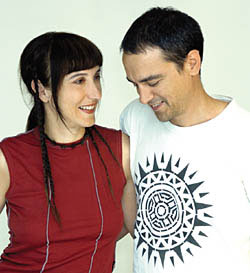
Photo: Theodore Xenos
“My younger brother was crazy with electronic things and he was fixing small radio receivers. All night through, when our parents would lock us inside our room to sleep, he would turn on and start fixing radios, and getting all this strange music from everywhere, and I was just listening. But this was not widely done. Not all the people were listening to such music in Greece, although now that I have started travelling a little bit more, I realise that Greeks, being merchants and people that travel a lot with boats, do have a very big openness to a lot of different kinds of music and you can discover African music, the East, Asia, in Greek music.”
“Kalamáta was one of the first areas of Greece where young tourists of the hippy generation would start coming and camping freely and living naturally next to the sea. They were a very, very different image in my eyes, seeing them coming to the hometown of my father, in the conservative Kalamáta. To suddenly see these colourful young people with long hair and guitars… they were like idols to me. I think that this is one of the reasons why later, when I became a teenager and in my 20s, I was listening to rock and psychedelic music and everything that was coming from the West, that was not yet accepted in Greece, and not widely heard. There were just a few very underground places where you could buy the albums of Velvet Underground, or Jefferson Airplane.
“As a child, we were living in a typical Athenian classical old house where they had marble stairs to get to the first floor and they had very nice reverb. First of all I was imitating all the rock singers of that time; Nico, Grace Slick, Patti Smith later. At the same time I was trying to imitate the voices of the Byzantine church because they had the same reverb in the churches. So I liked to improvise and experiment with the sound of the voice in the various places of the house, or the mountains sometimes.”
“I was playing with bands in high school, playing all this stuff. At the same time I was studying music and also trying to listen as much as possible to Greek traditional music which I loved. That was the time of the Greek junta, and unfortunately Greek traditional music had been used as a means of nationalist propaganda, and this made a large amount of people, mainly the people of the left, against traditional music. So I was afraid to even admit that I loved traditional music, because they would say ‘you’re nationalistic’. No, I’ve nothing to do with that. I hate that. It’s just the music that I love.”
“Practically my first job was when I was very young and I was selected in audition to play the role of Mary Magdalen in the rock opera Jesus Christ Superstar. There was an article in the newspaper asking for any amateur or professional actor or singer or musician that would like to come and audition. And I went there, and I sang the song of Mary Magdalen and they immediately said: ‘OK, we have Mary Magdalen, that’s her’. And this is how, let’s say, my profession started. This is how I earned the first money I ever earned in my life. Of course, after a few months I couldn’t stand the situation in the Greek music theatre, so I left. I quit and I started playing in various small clubs, at that time singing traditional Greek songs, ballads…”

Photo: Theodore Xenos
“There were one or two very underground clubs at the time in Athens. One was called Tipoúkitos, and that was the first place where I ever played. They were working for one month and then the police would close it . So I left that big famous theatre and I went to this club and that is how my path through all these small underground clubs in Athens started. I’m talking about ’79 now, I was very young, and at that place I was just performing with my guitar or one or two guitars. It was more acoustic, the sound.”
In 1983 came Eurovision. How did that happen?
“The person who had chosen me for the role of Mary Magdalen, the musical director who had done the arrangements for Jesus Christ Superstar, was a very famous middle-aged Greek musician whom everybody respects. He wanted to send a song to Eurovision and he asked me to sing the demo, but the demo was chosen as the song and so I went. At the same time, I liked the fact that I would travel freely to a European country, to Germany. One thing I remember was that Ofra Haza was playing with an Israeli band, before she had made her career.”
“So that was another experience for me. I was often doing things that people were insisting on telling me you should do, something more commercial in your career – so as to be able to do what you like afterwards. Two or three times in my life I have done this, and that was a mistake – but we learn from mistakes. I followed this advice, feeling that it might be the way to do what I really wanted on my own terms. But you can learn things from anything. Anyway this whole path was a zigzag among very strange things. Sometimes I was in the theatre. I was also studying drama; then I was studying Byzantine music; then I was studying classical singing, going to various teachers and various schools. I went to a school of drama, to the Greek art theatre of Károlus Khún, which was considered to be the most difficult and severe. I would just go around all these different things that had to do with experimenting with different sounds, with different arts, with ways to use your body, with ways to open up your creativity or your ability to communicate. I think that all these things made me what I am now and what I’m trying to become, slowly, slowly, as a person.”
“I also worked in a very big and famous production next to the Greek star Alíki Vougioukáki, like Brigitte Bardot would be in France. She made the big production of Evita years later. There I played Perón’s mistress. At the same time I was performing with some completely unknown musicians in very small clubs, under the name of a band so people wouldn’t realise, and I was doing a completely different thing. The moment when I started to do exactly and only what I wanted to concentrate on was in the ’90s, especially when I met Stathis.”
Stathis was a punk rocker. To this day he still wears a saz like Joe Strummer wore a Telecaster. What inspired that?
“It was The Ramones in ’78, ’79,” confides Stathis, who is mostly the silent partner throughout the interview. “I was listening to all kinds of music. From 12 I was listening to rock music, before 12 I was listening to rembetica, and suddenly I heard The Ramones. It was the time when I was bored with listening to all the rock. It was predictable.”
“We met in Án Club which was the most underground rock club in the Exárchia area of Athens,” remembers Kristi. “Exárchia area was where there were the punk groups and the outlaws and things like that and we met one night when I was playing, with another band that I had, doing covers of the Pretenders, Blondie, Kate Bush, and also some traditional Greek songs with strange anarchist, more rock arrangements. And that’s when we met and we started to play music together. We formed a group called Selána. That’s one of those groups where you have four musicians who are thrown together as if God has planned it, if we believe in God, and he just decided that ‘this man would fit with that one, and this one would fit with that girl, and let’s put them together and see what happens.’ And we got together and started playing and it was the first time in the life of all four of us that you wouldn’t tell the others ‘could you play that’ because they were playing what you were imagining.”

Photo: Yannis Voulparakis
“It was a sort of garage rock,” interjects Stathis. “Lots of people were shocked. Because new Greek music is conservative in the arrangements. In 10 years you hear the same sound. It’s not changing. For me it’s boring but not for most of the people. And we did something that was different.”
Selána never recorded but were minor legends on the club circuit.
“At that time,” points out Kristi, “and there still is, a distinction between commercial music and underground music and traditional music. In commercial music at that time, you wouldn’t dare play such strong sounds as we did. The indie groups were singing in English. If you dared sing in Greek they would say that you just wanted to make money, even if you sang about dying or something. Whatever the lyrics were, whatever the music was, for them you were then very commercial so you wouldn’t dare use Greek elements.”
Selána called a halt after a couple of years, by which time Stathis and Kristi were a couple. After making her first solo album Sti Límni Mé Tís Paparoúnes (By The Lake With The Poppies) in 1992, around the songs of friends Panayótis Kalatzópoulos and Evanthía Reboútsika, the pair were determined to stick to their own musical course. The first fruit of this – after a few years during which this multi-talented woman also published two books,Seven Times In Amorgos and The Fiery Sword - was the 1997 CD Ifantókosmos (The Woven World). Music by Stathis, lyrics and vocals by Kristi, the way they still work.
“Nobody from the big multinationals in Greece wanted to release Ifantókosmos. In the end we made the album and it was a kind of hit with the alternative audience, which could be of any age but is just listening to more experimental things and not what you can hear every day on the radio in Greece. At that time Ifantókosmos was very well accepted by these people. Actually, it gave us the chance to be able to talk with bigger labels, to be able to have our own terms. It made us somehow more commercial, but in a good sense.”
1999′s Echotropia followed, making their first dent in the World Music Charts Europe and with widening international ripples that included North American release and touring. Musically, it hinted at the path that would lead to The Secrets Of The Rocks. And with this latest album, the couple have become a really creative machine, somehow finding that elusive alchemist’s stone which allows them to create modern music that has global technological influences yet remains true to their roots, indisputably Greek in a modern world. Indeed, I suggest that they’re probably now more part of a global community of artists than a local one. Ears are opening everywhere as the world gets smaller, but their kindred spirits are in the musical anti-globalisation movement against the stuff that’s pushed by the multinational companies.
“You just expressed in very good English, better than ours, our feeling towards what we are doing and what is happening in music today,” confirms Kristi. “It’s exactly this. We can’t go on just listening to what has been produced in Anglo-Saxony, the big multinationals. It’s impossible. Why? Why should this happen?”
Stathis remembers being in Thailand in 1986. “In Europe we listened to music from Britain or the States. So when I went to Thailand I was shocked because I saw it was all Michael Jackson, Janet Jackson, Phil Collins, all those, like Hollywood. It was the only music that was coming from Europe or the States. There was no other music. It was so massive, like a bulldozer that destroys everything.”
“There is a whole ideological part behind the term world music and what all these artists are doing nowadays,” says Kristi. “It happened simultaneously in many areas, without the artists themselves having intended it or communicated. But this is not the first time that this has happened, and this is strange. This might have to do with astrology or the flow of energy around the planet. During the ’60s there wasn’t this world music thing going on but there was a certain period where all around the world you would have the arts flourishing in their own ways.”
“But anyway, apart from the ideological and the social parts of it, it’s fun. For me it is so much fun to discover music from around the world and to even try to do music or to use elements of music from around the world because this makes you travel as a musician. It gives you the feeling of travelling, because I believe that through music you can see the whole landscape around you. You can even feel the weather if you listen to the music, the way they sing. You can even feel the amount of humidity in the air of each country or how strong the winds blow there if you listen to the music.”
I wonder if, given their comments about the conservative attitudes to music prevalent in Greece, and thinking of the similar experiences of artists from other countries, they might have to achieve success abroad to make audiences at home really sit up and take notice.
“I don’t know. It happens to a lot of people. I don’t care that much. I mean, what I want to do is to have the ability first to communicate with people and be able to play the music I like to play, and the only reason why I would somehow struggle, or try or work hard to ‘get recognised’ is to get better conditions in our live performance. To have better sound; to be able to spend more time in the studio. This is what I care about. I don’t care about going out in the streets in Athens and people recognising me. Really, I don’t care about that. I’m not sure that the big audience in Greece will ever be interested in the music that I am making. I am very realistic about it. What I would like is that people really get the messages that come out from the music and the lyrics, and that they like it and they recognise this thing because of what it is.”

The Secrets Of The Rocks feels like a bigger jump than they made from Ifantókosmos toEchotropia, and comes across as a major achievement. Working largely at home – presumably in the very room where we’re sitting talking – they’ve managed to accomplish a potentially difficult blend of beats, electronica and rock instruments, traditional instruments like saz, bagpipes, lyre, flute and accordeon, roots influences and environmental sounds they recorded on the Greek islands in a way that comes across as completely natural. Stylistically the whole thing hangs together and I get the impression that there was considerable benefit from recording it in this way (Stathis himself is quite a multi-instrumentalist). At Womex, their really excellent live band was something different again. So I’m curious to know if this album is a one-off project or will the next one continue seamlessly on from it? I get a surprising answer…
“We started by saying we were going to create something very strange and unpredictable, but when we finished the album we were not satisfied by that. I think that we didn’t achieve the 100 percent that we wanted. And this will come in the next album. None of them up to now has achieved the feeling that we have in our minds. This is what we are trying to do. I hope that we won’t get 100 years old trying to achieve it in the end. We are always very much amazed when people like it…” And this, remember, was before it had hit No.1 on the World Music Charts Europe in December, which must have completely flummoxed them.
“We don’t believe it. I mean it. When we finished the mastering of this album we were both in a melancholy state. We quarrelled with Thalia because we said we didn’t want to release it. I was getting crazy. I said: ‘Let’s disappear from the world. I don’t want this album to go out.’ And she’s saying: ‘But why do you always say you don’t like it? It’s so good.’”
You’d better listen to Thalia then…
Stunned by this turn of opinion on one of my favourite albums of the year, I am temporarily bewildered. Can this be a Ry Cooder moment? I think I’d better change the subject, and ask if their encounters with other musicians on the global world music scene have thrown up any desires for collaborations. Yes indeed…
“First it was the Schäll Sick Brass Band from Germany, and it happened. It was so funny. And the Italians at Womex. And with Rory McLeod, I would like to co-operate with Rory. And then I would like to meet once in my life and maybe even co-operate with Sussan Deyhim and Richard Horowitz. They are a couple that I had been listening to from the end of the ’80s. I’ve never met them in festivals, it’s just their records. And many of the Indian musicians that we have met.”
“When you play with musicians or with singers from other countries,” considers Stathis, “it’s not only the similarities that we have in common, but it’s the differences which I like. I really felt it when we played with an Italian group in Canada. We were playing a traditional song and suddenly we heard something that we wouldn’t have imagined to put there, and it fitted so good.”
“At Winnipeg Festival,” recalls Kristi, “I was in a workshop with Rokia Traore. When it was my turn to do something and make all the rest jam – they were just singers – we improvised on Epirotica, songs from Epirus. That was my first workshop in front of hundreds of people, and I said: ‘Oh my God, what shall I do?’ I hadn’t had any experience like that before. OK, jamming with musicians in my house or in small clubs I had done, but improvising in front of people in a big festival I had never tried. And I said let’s sing an Epirotica song which is pentatonic; the Indian woman would love it and Rokia of course would understand it, and it was a very nice jam that came out of it.”
“I do hate this very strict attitude that traditional musicians have, especially in Greece, and I hear also elsewhere, that they don’t want to touch it and to change it. But, let’s make a point for them. There is a kind of rightness behind this idea, like for example there are some things that you can do and some other things that you cannot do because it is narrowing the richness of the tradition; the use of smaller tones in Byzantine music and singing, is something that was destroyed and disappeared. This is an element that should be kept. It widens the ability of the ear to hear. So let’s not mix, let us say, Byzantine music with rock instruments that would destroy some of the elements that are its value. In that part, those people that are very severe have a point. I am for the other side, of course…”
“The music is ours anyway, but to tell you something else, in none of these albums were we ‘heading towards’ something. I mean there was never an intention behind us to use this part of the tradition or use this part of rock, it’s just coming out of this thing that you have in your mind, and there it is, the tradition. It’s not an intentional thing. It’s not a decision that we make and we follow it. And we really don’t know how what we will do will sound next time.”
Stathis gets out a slide projector and shows some images from their many visits to the Greek islands which inspired the new record.
“I’d like a chance to say a little bit about what made us make this album,” says Kristi. “This is a very big part of our life together, and the most beautiful part. One part is the writing of music and playing around the world, and the feeling of this world music community that we were talking about, and the other thing is a kind of a Zen situation when we are just with a small guitar and my flute, by the sea, with nothing, just with sleeping bags, sometimes also with a tent, with very, very few things… and with the minidisc. Years ago we had much more time to do this. Nowadays we are travelling a lot, especially in the summers, but we also do it before the summer season.”
“It’s an experience that has to do with living by the sea, freely, naturally, being nude all day, living with very few things, just some water and fruit, and the shadow. This is somehow the thing that I want to get across to people – I am talking about the lyrics now, how it started. At the same time, Stathis was playing the tunes that we later produced here. This trance situation that you have when you are living near nature, but especially the very minimal nature that you get in some areas of the Cycladic islands or the south of Greece, where there are no trees, there are few plants, there are rocks and the sea. There are goats and lizards – they are both my very good friends. The sounds of such a place is what we wanted to create with this album. The Secrets Of The Rocks is not a surrealistic term, it’s very realistic. If you fall asleep at night on a rocky beach with pebbles, and the wind changes so often during the night so the waves are smaller or bigger, you get a kind of crazy sound of whispers, hints, laughters, steps. You have all sorts of different sounds that even frighten you sometimes. And this creates another world. This is the world that we try to reproduce. You become very sensitive to sounds when you live without electricity and without cars around you. I believe that what is very much more important than just listening to the music that is being released, is to be able to listen to the music which is happening around you every moment.”
Whatever their production secret is, there are quite a few other people who have tried to sample environmental sounds on records, and have ended up coming over as just extremely pretentious. On The Secrets Of The Rocks, these elements integrate so well and contribute to the record having an overall ambience, feeling like a complete work. Water, rocks, the whispering wind, the engines of the old Greek kaïkia fishing boats adding an industrial element as a loop. Perhaps they’re the glue that holds all the tracks together, the blood that runs through its veins…
“It’s not accidental that it reminds you of the blood, because there’s a whole community of people that live this way in Greece, a small community mainly of young people, and there is a connection between them. There is a common way of living. There is a belief that these places should be left free. Tourism sometimes becomes very bad for Greece.”
But isn’t there a danger that by releasing this CD they might be attracting more people to the very places they want to protect? The superb video that they’ve recently made for The Secrets Of The Rocks, filmed among the goats on the scrubby hills and rocky beaches of the island of Astypalaia is so outrageously, gorgeously evocative that it makes you want to grab your backpack and head there immediately…
“Attracting people that get moved by such a sound is a good thing. Such people were attracted by Kalamáta back in the ’60s. That was part of the hippy movement at the time. These are good movements, I believe. But most of the Greek areas that are like we describe in the album have now become like Goa, unfortunately. And this is the social message that I would love to communicate through these songs: that the places should be left like that. We should care about these places and leave their beauty as it is, not try to make it more beautiful in our own terms.”
The conversation diverts into a discussion about how her lyrics are very impressionistic, painting with words. I’m sure that when she is singing them her head must be filled with pictures. I advance my theory about how you can tell whether a singer has a picture in their head – be it a single still image of a place or a person, or a whole film where the song has a story to tell. Some singers transmit the picture, others you can tell are just making noises with their mouths, concentrating on the sound rather than the soul.
“Everybody can tell that. The audience is so wise. They have a link with you. For years I was performing almost every night in different places in small clubs and with bad conditions all the time, because I was never a mainstream artist. But whenever I had the image in my mind while I was singing, the audience was like in a mystical dream, they were with me. But a part of the joy also for a singer, is to listen to the sound that you can produce with your voice and change it and make people feel the vibrations of the sound. This is also a nice thing. When it’s done mechanically, it’s horrible, and when it’s done egotistically it’s horrible. But when it’s done artistically, it’s like when you cook – when you put in a little more breathing, or a little less breathing, it’s also a joy that can help you concentrate on the image. The most important thing for a singer is to have both included in one.”
As the The Secrets Of The Rocks deservedly conquers the international world music market, most people hearing it aren’t going to understand the words – since not that many people outside Greece speak Greek. I tell her that she has captured something that comes across without understanding the language. It turns out that I’m not the first person to realise this…
“When we were in Montreal last summer, we were invited by a professor of comparative religion to his lecture, to talk to his students and answer their questions. A month before he had given his students an examination and had made them listen to Echotropia without telling them who the artists were, where they came from, what the album was. He gave them four songs from Echotropia and one from Ifantókosmos and they had to listen, and then write small essays of one paragraph about what feelings they got from the songs. And then after he read all these small essays to everybody, he revealed that these were artists from Greece.”
“The small paragraphs that the students had written were the nicest things about our music that I have heard in my life. They really made us feel so moved. And the funny and very interesting thing is that they had understood most of the lyrics. In some cases they even had the same word! He had made them listen to the song Pyretos - Fever, fromIfantókosmos, and the guy had written, a young student of 18 years old: ‘It’s like Jimi Hendrix is jamming with Moroccan musicians, and the Moroccan singer is singing about a snake embracing her.’ And that was Stathis and me and I was singing the lyrics ‘you are embracing me like a snake.’ Another song was Anixandário, and someone had written: ‘This looks like a religious hymn’ – and it is based on a Byzantine hymn. The title of the song is a Byzantine word, it’s not used in the common Greek language. So he had written: ‘This is a religious song and I feel that this type of singing must have been made by the Sirens while Odysseus was passing by. This must have been how the songs of the Sirens sounded. It must be Greek.’ He had never heard the Greek language. We were very interested in that. So I feel that people don’t understand the lyrics word by word, but in some cases – not all the time – they get the feeling of the song which is really describing the lyrics in a way.”
And that, I conclude, might just be Kristi Stassinopoulou’s very special talent – and a useful one to have in this shrinking world of babel.

